
Certificate: View Certificate
Published Paper PDF: View PDF
Raghav Patel
Independent Researcher
India
Abstract
In the rapidly evolving landscape of education, digital learning environments (DLEs) have emerged as pivotal platforms for fostering critical thinking among learners. Critical thinking—the ability to analyze information, evaluate evidence, and construct reasoned arguments—is essential for success in the twenty‑first century. This manuscript investigates instructional strategies, technological affordances, and learner behaviors that promote critical thinking within DLEs. Drawing on constructivist learning theory and the Community of Inquiry framework, we conducted a mixed‑method study involving 150 undergraduate students enrolled in fully online courses. Quantitative data were gathered through pre‑ and post‑test assessments of critical thinking skills using the Watson–Glaser Critical Thinking Appraisal; qualitative insights were derived from focus groups and learner interaction logs. Results indicate significant gains in critical thinking performance (p < .001), closely linked to collaborative discussion forums, scaffolded problem‑based assignments, and reflective journaling tools.
Moreover, our findings reveal nuanced interactions between learner agency and technological design: students who actively engaged in peer‑led debates and iterative drafts reported heightened metacognitive awareness, while those who utilized analytics dashboards to track their own progress demonstrated greater self‑regulated learning behaviors. The integration of multimedia case studies further enriched the learning experience, allowing students to confront complex, real‑world scenarios that necessitated evidence‑based reasoning and adaptive problem‑solving. Importantly, instructors who provided timely, targeted feedback not only reinforced correct reasoning pathways but also challenged misconceptions, thereby deepening cognitive presence.
The educational significance of these findings lies in the demonstration that well‑designed DLEs can not only replicate but also enhance traditional classroom opportunities for critical thinking. By aligning social, cognitive, and teaching presence, digital platforms can foster sustained intellectual engagement, collaborative knowledge construction, and reflective practice—key components of transformative learning. Implications for curriculum design, instructor training, and platform development are discussed, emphasizing scalable strategies to cultivate discerning, analytical thinkers capable of navigating an increasingly complex information ecosystem.
Keywords
Critical thinking; digital learning environments; online pedagogy; constructivist instruction; Community of Inquiry
References
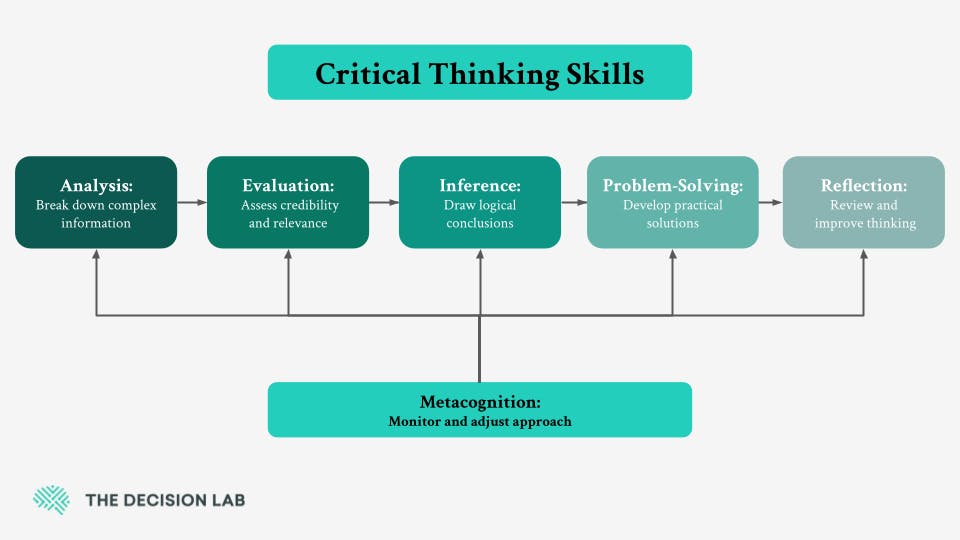
- https://images.prismic.io/thedecisionlab/Z0SGg68jQArT1Ro-_criticalthinkingskillsflowchart.png?auto=format,compress
- https://i.ytimg.com/vi/EvzUSnccKDk/maxresdefault.jpg
- Anderson, T., Rourke, L., Garrison, D. R., & Archer, W. (2001). Assessing social presence in asynchronous text‐based computer conferencing. Journal of Distance Education, 14(2), 50–71.
- Anderson, T. (2008). The theory and practice of online learning (2nd ed.). Athabasca University Press.
- Arbaugh, J. B. (2007). An investigation of epistemological and social dimensions of teaching in online learning environments. Academy of Management Learning & Education, 6(4), 534–556.
- Arbaugh, J. B., Cleveland‑Innes, M., Díaz, S. R., Garrison, D. R., Ice, P., Richardson, J. C., & Swan, K. P. (2008). Developing a community of inquiry instrument: Testing a measure of the Community of Inquiry framework using a multi‐institutional sample. The Internet and Higher Education, 11(3–4), 133–136.
- Braun, V., & Clarke, V. (2006). Using thematic analysis in psychology. Qualitative Research in Psychology, 3(2), 77–101.
- Chen, B., DeNoyelles, A., & Patton, K. (2012). Personal learning environments and context‐aware learning: Tools and strategies. Journal of Educational Technology Development and Exchange, 5(1), 1–17.
- Creswell, J. W., & Plano Clark, V. L. (2011). Designing and conducting mixed methods research (2nd ed.). SAGE Publications.
- Dewey, J. (1933). How we think: A restatement of the relation of reflective thinking to the educative process. D.C. Heath.
- Garrison, D. R., Anderson, T., & Archer, W. (2000). Critical inquiry in a text‐based environment: Computer conferencing in higher education. The Internet and Higher Education, 2(2–3), 87–105.
- Hrastinski, S. (2008). Asynchronous and synchronous e‐learning. EDUCAUSE Quarterly, 31(4), 51–55.
- Jonassen, D. H. (2000). Toward a design theory of problem solving. Educational Technology Research and Development, 48(4), 63–85.
- Kennedy, D., & Levy, M. (2008). L2 CALL communities: Web 2.0 and beyond. Canadian Modern Language Review, 64(4), 396–416.
- Pintrich, P. R. (2004). A conceptual framework for assessing motivation and self‐regulated learning in college students. Educational Psychology Review, 16(4), 385–407.
- Salmon, G. (2000). E‑moderating: The key to teaching and learning online. Routledge.
- Selwyn, N. (2007). The use of computer technology in university teaching and learning: A critical perspective. Journal of Computer Assisted Learning, 23(2), 83–94.
- Shea, P., & Bidjerano, T. (2010). Learning presence: Towards a theory of self‐efficacy, self‐regulation, and the development of communities of inquiry in online and blended learning environments. Computers & Education, 55(4), 1721–1731.
- Shea, P., Swan, K., & Pickett, A. (2005). A follow‐up investigation of “teaching presence” in the SUNY Learning Network. Journal of Asynchronous Learning Networks, 9(2), 7–23.
- Vygotsky, L. S. (1978). Mind in society: The development of higher psychological processes. Harvard University Press.
- Watson, G., & Glaser, E. M. (2006). Watson–Glaser Critical Thinking Appraisal. Pearson.
- Zhang, D., Zhao, J. L., Zhou, L., & Nunamaker, J. F., Jr. (2004). Can e‐learning replace classroom learning? Communications of the ACM, 47(5), 75–79.