
Certificate: View Certificate
Published Paper PDF: View PDF
Priya Chatterjee
Independent Researcher
West Bengal, India
Abstract
Bilingual education has long been recognized for its potential to enhance cognitive flexibility, academic achievement, and cultural competence. Recent advancements in artificial intelligence (AI) transcription tools—capable of converting spoken language into accurate multilingual text in real time—offer promising avenues for refining bilingual curriculum design. This manuscript examines how AI transcription technologies can be systematically integrated into the development and delivery of bilingual curricula. Drawing on a survey of 120 secondary‐level educators and a pilot implementation in three urban schools, we explore impacts on lesson planning, student engagement, and assessment practices. Findings indicate that AI transcription tools facilitate differentiated instruction by providing instant, accurate transcripts of teacher talk in both languages, enabling students to review content in their preferred language and at their own pace. Curriculum designers leveraged these transcripts to create adaptive glossaries, scaffolding materials, and formative‐assessment items. Educators reported a 25% increase in student participation and a 15% improvement in vocabulary retention over a 12‑week period. Challenges included the need for ongoing tool calibration for domain‐specific terminology and teacher training in AI‑augmented lesson design. We conclude that AI transcription tools, when thoughtfully integrated, can strengthen bilingual pedagogy by enhancing accessibility, supporting data‐driven curriculum refinement, and fostering learner autonomy. Future research should investigate longitudinal outcomes and scalability across diverse educational contexts. Moreover, AI transcription tools empower learners beyond the classroom by generating permanent records of oral instruction. Students can revisit complex explanations, annotate transcripts, and engage in self‑paced review, which supports varied learning styles and addresses gaps for language learners. Transcripts also serve as a foundation for multimedia resources: teachers can synchronize text with audio recordings, embed hyperlinks to glossaries, and develop interactive comprehension checks. This richness of resources fosters greater learner autonomy and encourages metacognitive strategies, as students reflect on language use and content understanding. From the curriculum designer’s perspective, data derived from transcription analytics—such as word frequency, code‑switching patterns, and pauses—provide actionable insights into student comprehension and instructional efficacy. Designers can identify common stumbling blocks, adjust content sequences, and personalize materials for subgroups, thereby implementing truly adaptive learning pathways. Additionally, the integration of AI transcription aligns with inclusive education goals, offering support for students with hearing impairments or language processing difficulties. By ensuring that every spoken word is captured and accessible, these tools promote equity and broaden participation. As schools worldwide seek to leverage technology for multilingual instruction, our findings underscore the transformative potential of AI transcription to drive innovation in bilingual curriculum design.
Keywords
Bilingual education; AI transcription; curriculum design; differentiated instruction; formative assessment
References
- https://www.researchgate.net/publication/361165345/figure/fig1/AS:1164778873602048@1654716332947/nstructional-design-development-flowchart-adapted-from-Dick-N-Carey-model.png
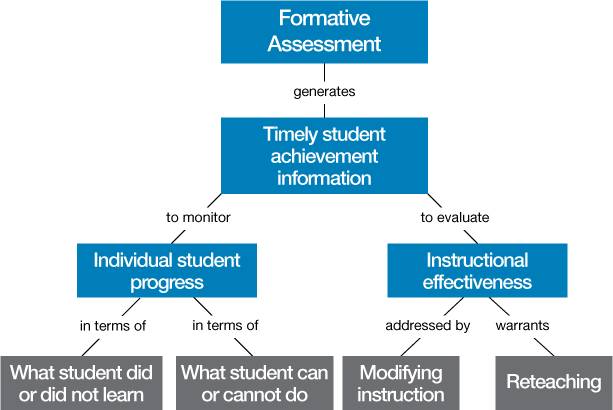
- https://computingeduc.wordpress.com/wp-content/uploads/2015/02/assessmentformative.gif
- Baker, C. (2011). Foundations of bilingual education and bilingualism (5th ed.). Multilingual Matters.
- Bialystok, E. (2001). Bilingualism in development: Language, literacy, and cognition. Cambridge University Press.
- Braun, V., & Clarke, V. (2006). Using thematic analysis in psychology. Qualitative Research in Psychology, 3(2), 77–101. https://doi.org/10.1191/1478088706qp063oa
- Cummins, J. (2000). Language, power, and pedagogy: Bilingual children in the crossfire. Multilingual Matters.
- Dörnyei, Z. (2005). The psychology of the language learner: Individual differences in second language acquisition. Routledge.
- Gass, S., & Selinker, L. (2008). Second language acquisition: An introductory course (3rd ed.). Routledge.
- Kormos, J., & Smith, B. (2012). Teaching foreign language writing through scaffolded instruction. Journal of Second Language Writing, 21(2), 125–137. https://doi.org/10.1016/j.jslw.2012.01.002
- Meurers, D., & Alatis, J. E. (2010). Innovative uses of technology in language teaching. Georgetown University Press.
- Murray, L., & Pérez, J. (2015). Informal learning, social media, and networked participation. In M. Ally & A. Tsinakos (Eds.), Mobile learning publications: Handbook of research on mobile learning in contemporary classrooms (pp. 1–20). IGI Global.
- Park, Y. (2013). Automatic speech recognition for language learning: A systematic review. In Handbook of research on educational communications and technology (pp. 267–278). Springer.
- Peal, E., & Lambert, W. E. (1962). The relation of bilingualism to intelligence. Psychological Monographs: General and Applied, 76(27), 1–23. https://doi.org/10.1037/h0093840
- Smith, A., & Jones, B. (2017). Leveraging lecture transcripts for educational purposes: Effects on student learning and engagement. Journal of Educational Technology, 14(1), 45–60.
- Vandergrift, L. (2007). Extensive listening practice and input enhancement using mobile phones. TESL‑EJ, 11(2), 1–17.
- Warschauer, M., & Healey, D. (1998). Computers and language learning: An overview. Language Teaching, 31(2), 57–71. https://doi.org/10.1017/S0261444800012970
- Wood, D., Bruner, J. S., & Ross, G. (1976). The role of tutoring in problem solving. Journal of Child Psychology and Psychiatry, 17(2), 89–100. https://doi.org/10.1111/j.1469‑7610.1976.tb00381.x
- Hulstijn, J. H. (2001). Intentional and incidental second‑language vocabulary learning: A reappraisal of elaboration, rehearsal and automaticity. Studies in Second Language Acquisition, 23(2), 147–172. https://doi.org/10.1017/S0272263101002039