
Certificate: View Certificate
Published Paper PDF: View PDF
Pramod Pandey
Independent Researcher
Uttar Pradesh, India
Abstract
Interdisciplinary approaches in high school humanities attempt to dissolve the artificial boundaries that have historically separated literature, history, philosophy, sociology, political science, anthropology, and the arts. This manuscript argues that authentic problems—climate justice, migration, gender equity, digital surveillance, democratic participation—cannot be understood or addressed through a single disciplinary lens. Drawing on constructivist, sociocultural, and transformational learning theories, it proposes a coherent design for integrating disciplines around essential questions, inquiry cycles, and project-based tasks. Using a mixed-methods methodology encompassing curriculum mapping, a quasi-experimental design in three Indian high schools, and thematic analysis of student artifacts (N = 180) and teacher interviews (N = 18), the study explores the impact of interdisciplinarity on critical thinking, empathy, historical consciousness, and transfer of learning. Quantitative findings indicate statistically significant gains in critical thinking (p < .01) and perspective-taking (p < .05) for the treatment group compared to controls. Qualitative results highlight students’ enhanced ability to synthesize multiple sources, challenge dominant narratives, and situate personal experiences within broader socio-historical contexts. The manuscript concludes with a framework for implementation that includes backward design, co-teaching models, assessment rubrics calibrated to interdisciplinary outcomes, and professional learning communities. Educational significance lies in aligning humanities education with twenty-first century competencies, national curriculum frameworks, and the Sustainable Development Goals (SDGs). The paper also surfaces tensions—coverage versus depth, teacher workload, assessment constraints—and offers pragmatic strategies to navigate them. Ultimately, it argues that interdisciplinary humanities are not an optional enrichment but a necessary architecture for cultivating ethically grounded, critically literate citizens in an interconnected world.
Keywords
Interdisciplinary curriculum; humanities education; high school; critical thinking; project-based learning; constructivism; mixed methods; assessment; empathy; transformative learning.
References
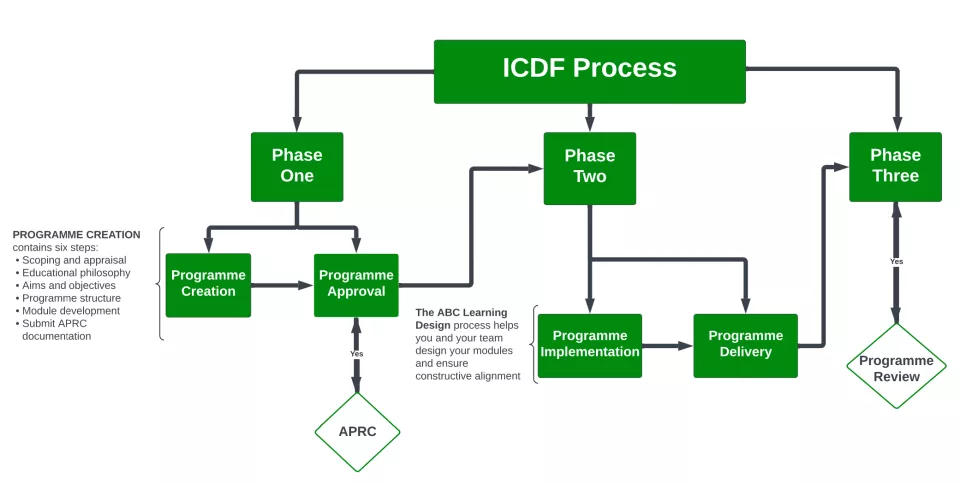
- https://www.ul.ie/sites/default/files/styles/width_of_content_area/public/2024-05/ICDF%20Process%20diagram%20from%20pdf.PNG.webp?itok=fZ-XNg4U
- https://www.dataworks.ie/wp-content/uploads/Capture-1.png
- Drake, S. M., & Burns, R. C. (2004). Meeting standards through integrated curriculum. ASCD.
- Endacott, J. L., & Brooks, S. (2013). An updated theoretical and practical model for promoting historical empathy. Social Studies Research and Practice, 8(1), 41–58.
- Fogarty, R. (1991). Ten ways to integrate curriculum. Educational Leadership, 49(2), 61–65.
- Jacobs, H. H. (1989). Interdisciplinary curriculum: Design and implementation. ASCD.
- Klein, J. T. (1990). Interdisciplinarity: History, theory, & practice. Wayne State University Press.
- Mezirow, J. (1991). Transformative dimensions of adult learning. Jossey-Bass.
- Newell, G. E., Beach, R., Smith, J., VanDerHeide, J., Kuhn, D., & Andriessen, J. (2011). Teaching and learning argumentative reading and writing: A review of research. Reading Research Quarterly, 46(3), 273–304. https://doi.org/10.1002/RRQ.002
- Parker, W. C., Mosborg, S., Bransford, J., Vye, N., Wilkerson, J., & Abbott, R. (2013). Rethinking advanced high school coursework: Tackling the depth/breadth tension in the AP U.S. Government and Politics course. The Social Studies, 104(3), 165–170. https://doi.org/10.1080/00377996.2012.665060
- Sadler, T. D. (2004). Informal reasoning regarding socioscientific issues: A critical review of research. Journal of Research in Science Teaching, 41(5), 513–536. https://doi.org/10.1002/tea.20009
- Spiro, R. J., Feltovich, P. J., Jacobson, M. J., & Coulson, R. L. (1992). Cognitive flexibility, constructivism, and hypertext: Random access instruction for advanced knowledge acquisition in ill-structured domains. Educational Technology, 31(5), 24–33.
- Vygotsky, L. S. (1978). Mind in society: The development of higher psychological processes. Harvard University Press.
- Wineburg, S. (2001). Historical thinking and other unnatural acts: Charting the future of teaching the past. Temple University Press.
- Beane, J. A. (1997). Curriculum integration: Designing the core of democratic education. Teachers College Press.
- Bransford, J. D., Brown, A. L., & Cocking, R. R. (Eds.). (2000). How people learn: Brain, mind, experience, and school (Expanded ed.). National Academies Press.
- Shulman, L. S. (1986). Those who understand: Knowledge growth in teaching. Educational Researcher, 15(2), 4–14. https://doi.org/10.3102/0013189X015002004