
Certificate: View Certificate
Published Paper PDF: View PDF
Nilesh Chauhan
Independent Researcher
Himachal Pradesh, India
Abstract
Global Citizenship Education (GCE) aims to cultivate learners’ understanding of global interdependence, social justice, and cultural diversity. In the context of Indian international schools—institutions that blend internationally benchmarked curricula such as the IB and CAIE with India’s pluralistic cultural milieu—GCE assumes particular significance in preparing students for meaningful participation in a globally interconnected world. This manuscript investigates the impact of GCE initiatives on students’ awareness, attitudes, and behaviors in three geographically and socioeconomically diverse Indian international schools (metropolitan Mumbai, tech‑hub Bengaluru, and culturally rich Kolkata). Employing a convergent parallel mixed‑methods design, we combine quantitative pre‑ and post‑intervention surveys of 100 Grade 10–12 students with in‑depth interviews of educators and students, as well as structured classroom observations.
Baseline and follow‑up survey data reveal statistically significant gains in global awareness (mean increase from 3.1 to 4.2 on a 5‑point scale), intercultural sensitivity (3.4 to 4.0), and civic engagement intentions (3.0 to 3.6). Qualitative findings illuminate how project‑based service learning—ranging from refugee narrative workshops to sustainability audits—deepens empathetic understanding and critical reflection on systemic inequities. Teachers report enhanced student initiative in organizing community outreach, though long‑term project continuity varies by institutional support. Observational rubrics confirm that lessons embedding critical discussion prompts and collaborative inquiry yield richer learner engagement than standalone modules.
Beyond empirical measures, this study contributes theoretically by articulating a context‑specific model of GCE implementation in Indian international schools, foregrounding the roles of leadership commitment, teacher professional development, and structured NGO partnerships. Practically, it offers a stepwise framework for integrating GCE across subject disciplines, leveraging reflection cycles, and institutionalizing service‑learning to translate awareness into sustained civic action. Finally, by identifying resource constraints—such as limited funding for field projects and uneven teacher training—this research highlights sites for policy intervention. Collectively, the findings underscore that, when embedded holistically and supported by robust infrastructure, GCE not only elevates global consciousness but also nurtures empowered young citizens capable of initiating positive social change.
Keywords
Global Citizenship Education; Indian International Schools; Intercultural Competence; Civic Engagement; Sustainability
References
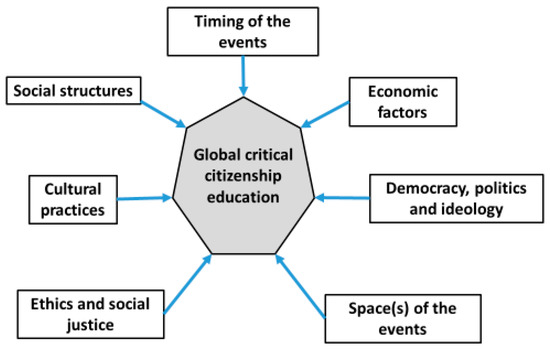
- https://www.mdpi.com/socsci/socsci-09-00065/article_deploy/html/images/socsci-09-00065-g001-550.jpg
- https://www.researchgate.net/publication/306034741/figure/fig17/AS:393917502640129@1470928659017/Dimensions-and-flow-chart-of-sustainability-assessments-modified-after-Binder-et-al-36.png
- Andreotti, V. (2006). Soft versus critical global citizenship education. Policy & Practice: A Development Education Review, (3), 40–51.
- Banks, J. A. (2008). Diversity, group identity, and citizenship education in a global age. Educational Researcher, 37(3), 129–139. https://doi.org/10.3102/0013189X08317501
- Bennett, M. J. (1993). Towards ethnorelativism: A developmental model of intercultural sensitivity. In R. M. Paige (Ed.), Education for the intercultural experience (pp. 21–71). Intercultural Press.
- Braun, V., & Clarke, V. (2006). Using thematic analysis in psychology. Qualitative Research in Psychology, 3(2), 77–101. https://doi.org/10.1191/1478088706qp063oa
- Creswell, J. W., & Plano Clark, V. L. (2011). Designing and conducting mixed methods research (2nd ed.). SAGE Publications.
- Dower, N. (2002). Global citizenship: Metaphor or meaning? Crossroads, XII(1), 5–16.
- Hayden, M., & Thompson, J. (2013). International schools: Antecedents, current issues and metaphors for the future. In C. A. Torres & A. Teodoro (Eds.), Globalization and education reform (pp. 184–205). Springer.
- Lee, W. O., & Syed, J. (2011). Global citizenship education in the International Baccalaureate Diploma Programme in Singapore. Journal of Research in International Education, 10(1), 47–66. https://doi.org/10.1177/1475240911407801
- McCloskey, K. (2014). Linking global learning to action: Implications for global citizenship education. Educational Review, 66(1), 22–38. https://doi.org/10.1080/00131911.2013.807113
- Mitchell, T. D. (2008). Traditional vs. critical service‐learning: Engaging the literature to differentiate two models. Michigan Journal of Community Service Learning, 14(2), 50–65.
- Morgan, W. J. (2007). Teaching philosophically about the globalization of education: Why we should. Educational Theory, 57(3), 331–347. https://doi.org/10.1111/j.1741-5446.2007.00247.x
- Oxley, L., & Morris, P. (2013). Global citizenship: A typology for distinguishing its multiple conceptions. British Journal of Educational Studies, 61(3), 301–325. https://doi.org/10.1080/00071005.2013.798393
- Rizvi, F., & Lingard, B. (2010). Globalizing education policy. Routledge.
- Soria, K. M., & Troisi, J. (2014). Civic engagement and global citizenship in higher education: A mixed‐methods assessment of student learning. Journal of Student Affairs Research and Practice, 51(3), 252–264. https://doi.org/10.1515/jsarp-2014-0008
- (2015). Global citizenship education: Topics and learning objectives. UNESCO Publishing.
- Westheimer, J., & Kahne, J. (2004). What kind of citizen? The politics of educating for democracy. American Educational Research Journal, 41(2), 237–269. https://doi.org/10.3102/00028312041002237