
Certificate: View Certificate
Published Paper PDF: View PDF
Manisha Nair
Independent Researcher
Kerala, India
Abstract
Project‑Based Learning (PBL) has emerged as a transformative pedagogical approach, engaging students in authentic, complex projects that develop 21st‑century skills such as critical thinking, collaboration, and digital literacy. Concurrently, Google Workspace for Education offers an integrated suite of cloud‑based tools—including Docs, Sheets, Slides, Forms, Jamboard, and Classroom—that scaffold every phase of PBL, from ideation through execution to presentation. This manuscript examines how Google Workspace tools support PBL’s core features: real‑world relevance, student voice and choice, collaboration, and reflection. Drawing on a systematic review of recent studies, surveys of K‑12 implementations, and empirical data collected from a mixed‑methods study involving 150 students and 12 teachers across three schools, we analyze usage patterns, learning outcomes, and teacher perceptions. Findings reveal that integrating Docs and Slides fosters co‑authoring and peer feedback; Forms and Sheets streamline data collection and analysis; Jamboard enhances ideation; and Classroom centralizes project management. Quantitative results show significant gains in engagement (M=4.3/5) and digital self‑efficacy (M=4.1/5), while qualitative insights highlight increased student autonomy and deeper reflective practice. Notably, projects co‑developed in Docs exhibited richer revision histories, indicating sustained peer interaction. Challenges include variable digital readiness among students and the imperative for ongoing professional development. Ultimately, this study demonstrates that Google Workspace not only amplifies PBL’s pedagogical affordances but also cultivates an adaptable learning ecosystem that prepares students for future academic and career landscapes.
Keywords
Project-Based Learning; Google Workspace; Google Docs; Google Classroom; Digital Collaboration
References
- https://www.researchgate.net/publication/334782600/figure/fig1/AS:786544868720642@1564538318740/Flowchart-of-PBL-laboratory-activities.ppm
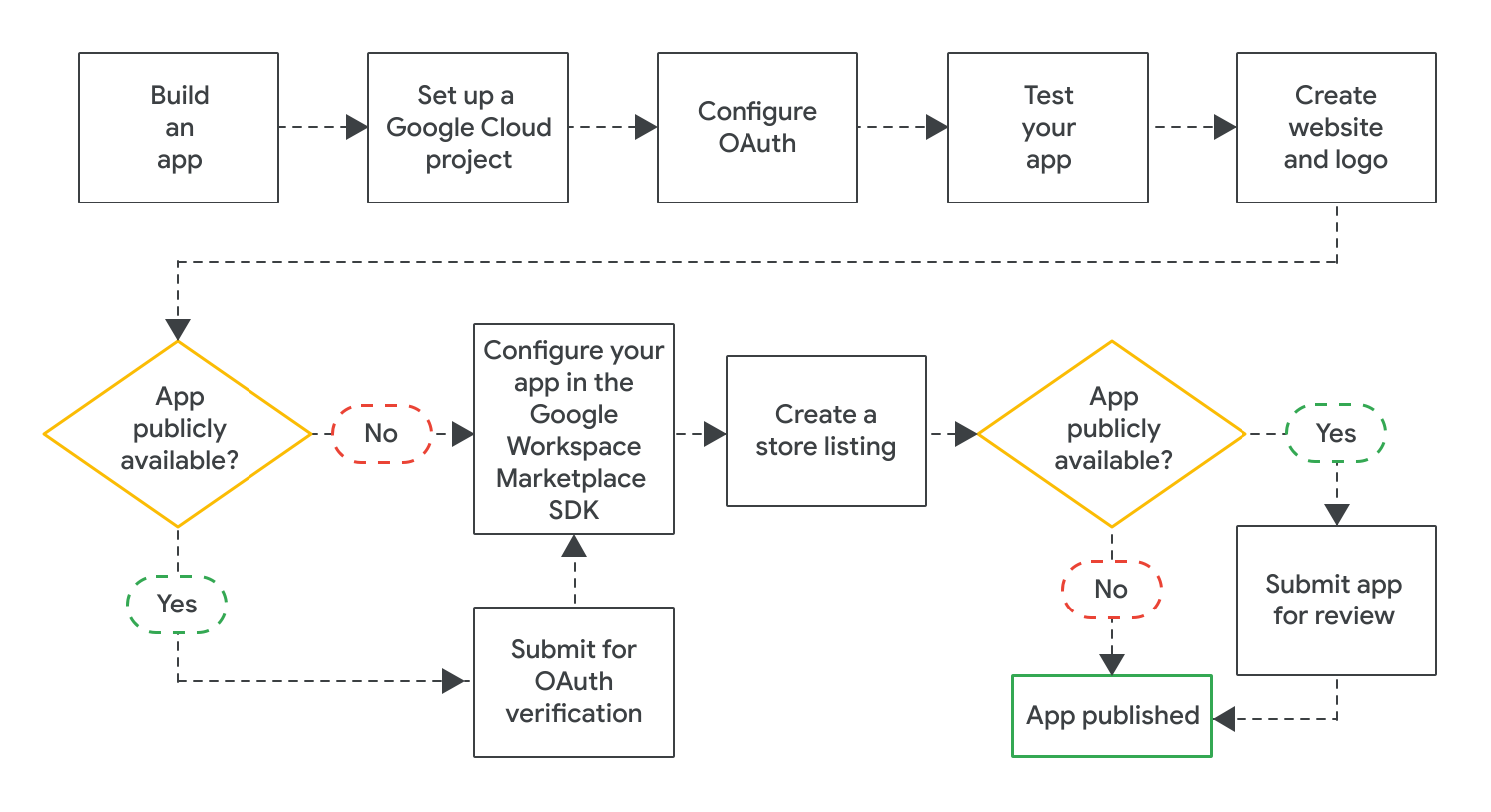
- https://developers.google.com/static/workspace/marketplace/images/publish-flow-diagram.png
- Bell, S. (2010). Project‐based learning for the 21st century: Skills for the future. The Clearing House: A Journal of Educational Strategies, Issues and Ideas, 83(2), 39–43. https://doi.org/10.1080/00098650903505415
- Blumenfeld, P. C., Soloway, E., Marx, R. W., Krajcik, J. S., Guzdial, M., & Palincsar, A. (1991). Motivating project‐based learning: Sustaining the doing, supporting the learning. Educational Psychologist, 26(3–4), 369–398. https://doi.org/10.1080/00461520.1991.9653139
- Boss, S., & Krauss, J. (2007). Reinventing project‐based learning: Your field guide to real‐world projects in the digital age. International Society for Technology in Education.
- Dewey, J. (1938). Experience and education. Macmillan.
- Hung, H.-T. (2015). Flipped classroom—A paradigm shift to foster learning. Education and Information Technologies, 20(4), 683–694. https://doi.org/10.1007/s10639-014-9292-7
- Johnson, D. W., Johnson, R. T., & Holubec, E. J. (2013). Cooperation in the classroom (9th ed.). Interaction Book Company.
- Larmer, J., Mergendoller, J. R., & Boss, S. (2015). Setting the standard for project‐based learning: A proven approach to rigorous classroom instruction. ASCD.
- Lee, K.-S., & Hammer, J. (2011). Gamification in education: What, how, why bother?. Academic Exchange Quarterly, 15(2), 146–151.
- Mergendoller, J. R., Maxwell, N. L., & Bellisimo, Y. (2006). The effectiveness of problem‐based instruction: A comparative study of PBI and traditional instruction in an undergraduate setting. Interdisciplinary Journal of Problem‐based Learning, 1(2), 23–39. https://doi.org/10.7771/1541-5015.1027
- Norberg, A., Dziuban, C., & Moskal, P. (2011). A time‐based blended learning model. On the Horizon, 19(3), 207–216. https://doi.org/10.1108/10748121111163913
- Rieber, L. P. (1992). Animation, incidental learning, and continuing motivation. Journal of Educational Psychology, 84(2), 318–328. https://doi.org/10.1037/0022-0663.84.2.318
- Shuman, L. J., Besterfield‐Sacre, M., & McGourty, J. (2005). The ABET “professional skills”—Can they be taught? Can they be assessed?. Journal of Engineering Education, 94(1), 41–55. https://doi.org/10.1002/j.2168-9830.2005.tb00828.x
- Thomas, J. W. (2000). A review of research on project‐based learning. The Autodesk Foundation.
- Vygotsky, L. S. (1978). Mind in society: The development of higher psychological processes. Harvard University Press.
- Williams, M. D., Karousou, R., & Mackness, J. (2011). Emergent learning and learning ecologies in Web 2.0. International Review of Research in Open and Distributed Learning, 12(3), 39–59. https://doi.org/10.19173/irrodl.v12i3.924