
Certificate: View Certificate
Published Paper PDF: View PDF
Ganesh Nair
Independent Researcher
Kerala, India
Abstract
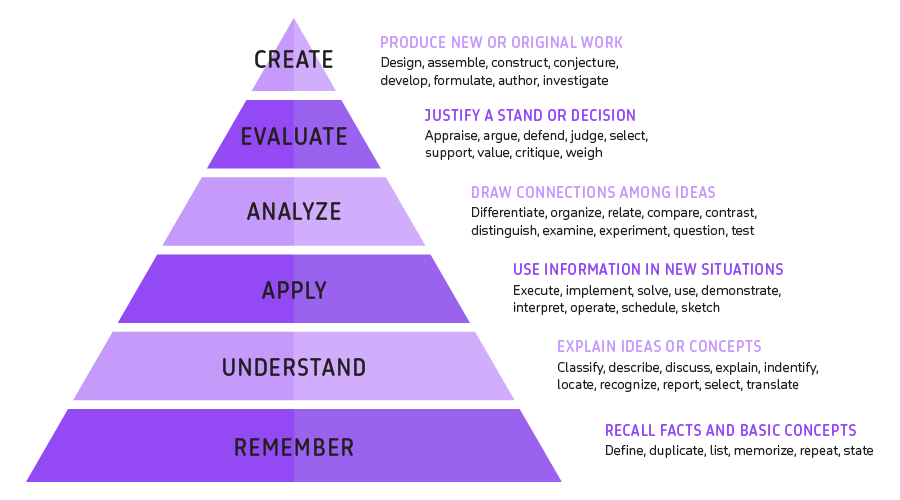
This manuscript examines the alignment of remote learning practices with Bloom’s Taxonomy of educational objectives within the evolving landscape of digital education. As remote instruction becomes increasingly prevalent—driven by global events like ongoing technological innovation—educators must ensure that online pedagogies foster not only knowledge acquisition but also the advancement of higher‑order cognitive processes such as analysis, synthesis, and evaluation. To address this, we conducted a mixed‑methods study involving surveys of 150 university instructors across diverse disciplines, in‑depth interviews with twenty educators, and comprehensive artifact analyses of thirty fully online courses. Our investigation identifies both prevalent instructional strategies—such as video lectures with embedded quizzes, discussion forums, and adaptive simulations—and critical gaps in supporting the taxonomy’s upper levels. Quantitative results reveal strong alignment at the Remember and Understand stages but increasingly sparse representation at Apply, Analyze, Evaluate, and Create. Qualitative insights uncover barriers including insufficient training in interactive technologies, concerns over academic integrity, and the significant time investment required to design scaffolded experiences. Drawing on these findings, we propose a practical framework of best practices that integrates stepwise scaffolding, collaborative technologies, reflective assessments, and AI‑driven feedback to bolster higher‑order engagement. This framework offers actionable guidance for curriculum designers, instructional technologists, and instructors, aiming to optimize remote learning environments for robust cognitive development. By situating our contributions within both theoretical and applied contexts, this study advances understanding of how digital platforms can be leveraged to cultivate critical thinking, creative problem‑solving, and lifelong learning competencies essential for the 21st‑century knowledge economy.
Keywords
Remote learning, Bloom’s Taxonomy, educational alignment, higher‑order thinking, instructional design
References
- https://www.sacredheart.bkcat.co.uk/wp-content/uploads/2021/02/flow.png
- https://tophat.com/wp-content/uploads/Blooms-Taxonomy-Explained.png
- Alleman, T. L., & Brodeur, C. (2004). Primary barriers for distance learners in a rural state. Quarterly Review of Distance Education, 5(4), 419–430.
- Anderson, L. W., & Krathwohl, D. R. (Eds.). (2001). A taxonomy for learning, teaching, and assessing: A revision of Bloom’s taxonomy of educational objectives. Longman.
- Bloom, B. S., Engelhart, M. D., Furst, E. J., Hill, W. H., & Krathwohl, D. R. (1956). Taxonomy of educational objectives: The classification of educational goals. Handbook I: Cognitive domain. David McKay.
- Forehand, M. (2005). Bloom’s taxonomy: Original and revised. In K. Krathwohl (Ed.), Emerging perspectives on learning, teaching, and technology. University of West Florida.
- Garrison, D. R., Anderson, T., & Archer, W. (2000). Critical inquiry in a text‐based environment: Computer conferencing in higher education. Internet and Higher Education, 2(2–3), 87–105.
- Garrison, D. R., & Cleveland‐Innes, M. (2005). Facilitating cognitive presence in online learning: Interaction is not enough. The American Journal of Distance Education, 19(3), 133–148.
- Gikandi, J. W., Morrow, D., & Davis, N. E. (2011). Online formative assessment in higher education: A review of the literature. Computers & Education, 57(4), 2333–2351.
- Hrastinski, S. (2008). Asynchronous and synchronous e‐learning: A study of asynchronous and synchronous e‐learning methods. EDUCAUSE Quarterly, 31(4), 51–55.
- Littlejohn, A., & Pegler, C. (2007). Preparing for blended e‐learning. Routledge.
- Moore, M. G., Dickson‐Deane, C., & Galyen, K. (2011). e‑Learning, online learning, and distance learning environments: Are they the same? Internet and Higher Education, 14(2), 129–135.
- Muilenburg, L. Y., & Berge, Z. L. (2005). Student barriers to online learning: A factor analytic study. Distance Education, 26(1), 29–48.
- Pohl, M. (2000). Learning to think, thinking to learn: Models and strategies to develop a classroom culture of thinking. Hawker Brownlow Education.
- Reeves, T. C., & Reeves, P. M. (2015). Effective instructional strategies for online learning environments. Journal of Applied Instructional Design, 4(1), 4–15.
- Salmon, G. (2013). E‑moderating: The key to teaching and learning online (3rd ed.). Routledge.
- Song, L., Singleton, E. S., Hill, J. R., & Koh, M. H. (2004). Improving online learning: Student perceptions of useful and challenging characteristics. Internet and Higher Education, 7(1), 59–70.
- Zhang, D., Zhou, L., Briggs, R. O., & Nunamaker, J. F., Jr. (2006). Instructional video in e‑learning: Assessing the impact of interactive video on learning effectiveness. Information & Management, 43(1), 15–27.