
Certificate: View Certificate
Published Paper PDF: View PDF
Sudeep Reddy
Independent Researcher
Telangana, India
Abstract
The rapid expansion of online schooling platforms has transformed educational delivery globally, presenting both unprecedented opportunities and significant challenges for inclusive learning. Students with special educational needs (SEN) frequently encounter barriers that undermine their access to high‑quality instruction, personalized support, and meaningful engagement. This manuscript investigates critical policy gaps in online education by examining accessibility compliance, adaptive pedagogical frameworks, teacher preparedness, and regulatory oversight. Employing a mixed‑methods design, we conducted a comprehensive policy analysis of federal, state, and international guidelines; surveyed 150 SEN students and their parents; and interviewed 20 special educators experienced in virtual instruction. Our findings reveal that only a minority of policies explicitly mandate digital accessibility standards, with 68% of survey respondents reporting inaccessible course content and 73% indicating insufficient individualized accommodations. Educators highlighted a pervasive lack of formal training in online special education strategies, leading to ad hoc workarounds and inconsistent support. Moreover, accountability measures seldom include metrics for monitoring SEN inclusion, reducing incentives for platforms to prioritize equitable design. Building on these insights, we propose a robust policy framework centered on universal design for learning (UDL), mandatory WCAG Level AA certification, targeted professional development, and integrated accountability indicators. By aligning legal mandates with technological best practices and pedagogical innovations, stakeholders can create online environments that not only comply with statutory requirements but also foster autonomy, engagement, and academic success for all learners. Implementing these recommendations will bridge existing gaps, promote systemic change, and ensure that no SEN student is left behind in the digital era.
Keywords
Special education policy gaps; online schooling platforms; accessibility; inclusive pedagogy; teacher training; regulatory standards
References
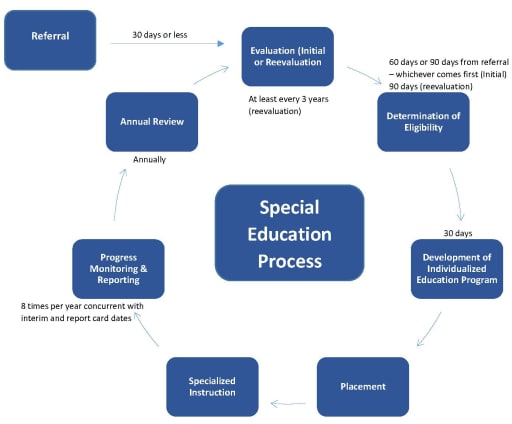
- https://resources.finalsite.net/images/f_auto,q_auto,t_image_size_2/v1697446966/ccpsorg/fzshwkyusbqxiqqmomu1/SpecialEducationProcess.jpg
- https://upload.wikimedia.org/wikipedia/commons/thumb/d/d6/SDWA_Regulatory_Analysis_Processes_-_Flowchart_-_EPA_2016.png/1024px-SDWA_Regulatory_Analysis_Processes_-_Flowchart_-_EPA_2016.png
- Al-Azawei, A., Serenelli, F., & Lundqvist, K. (2016). Universal Design for Learning (UDL): A content analysis of peer-reviewed journal papers from 2012 to 2015. Journal of the Scholarship of Teaching and Learning, 16(3), 39–55.
- Burgstahler, S. (2008). Universal design in education: Principles and applications. DO‑IT, University of Washington.
- (2018). Universal design for learning guidelines version 2.2. http://udlguidelines.cast.org
- Code of Federal Regulations. (2010). 34 C.F.R. § 300.8. Individuals with Disabilities Education Act (IDEA) Regulations.
- McGuire, J. M., Scott, S. S., & Shaw, S. F. (2006). Universal design for instruction: Transforming postsecondary education. Journal of Postsecondary Education and Disability, 19(2), 103–113.
- Rose, D. H., & Meyer, A. (2007). Teaching every student in the digital age: Universal Design for Learning. ASCD.
- Smith, S. J., & Jones, L. (2018). Digital inclusion in K–12 education: Policy implications. Educational Policy, 32(3), 520–550.
- (2015). Education 2030: Incheon Declaration and Framework for Action. United Nations Educational, Scientific and Cultural Organization.
- S. Department of Justice. (2018). Web accessibility guidance. https://www.ada.gov/web-guidance/
- Watson, J., Murin, A., Vashaw, L., Gemin, B., & Rapp, C. (2015). Keeping pace with K–12 digital learning. Evergreen Education Group.
- Zhang, D., Zhao, J., Zhou, L., & Nunamaker, J. F. (2004). Can e‑learning replace classroom learning? Communications of the ACM, 47(5), 75–79.